Supaviral Ads
How To Write AI UGC Ad Hooks Worth Testing
Build a practical hook test for AI UGC ads with concrete examples, a reusable prompt, and a simple way to compare creative variations.
An ad hook gives someone a reason to keep watching. It can introduce a familiar problem, show an unexpected use, or make a specific promise that the rest of the ad can support. A good starting point is three distinct angles, not thirty small rewrites of the same sentence.
1. Name The Viewer’s Situation
Describe a real context where the product helps. For a gym bag, “finding your keys at the bottom of a packed bag” is more concrete than “improve your lifestyle.” Your opening visual should make that situation recognizable.
Separate what you know from what you are assuming. Customer questions, support conversations, and product reviews can reveal useful language, but do not invent quotes or present generated dialogue as a real customer testimonial.
2. Write Three Different Hook Angles
Use a different reason to watch for each variation. These examples use an imaginary compartmented gym bag; adapt them only to features your product actually has.
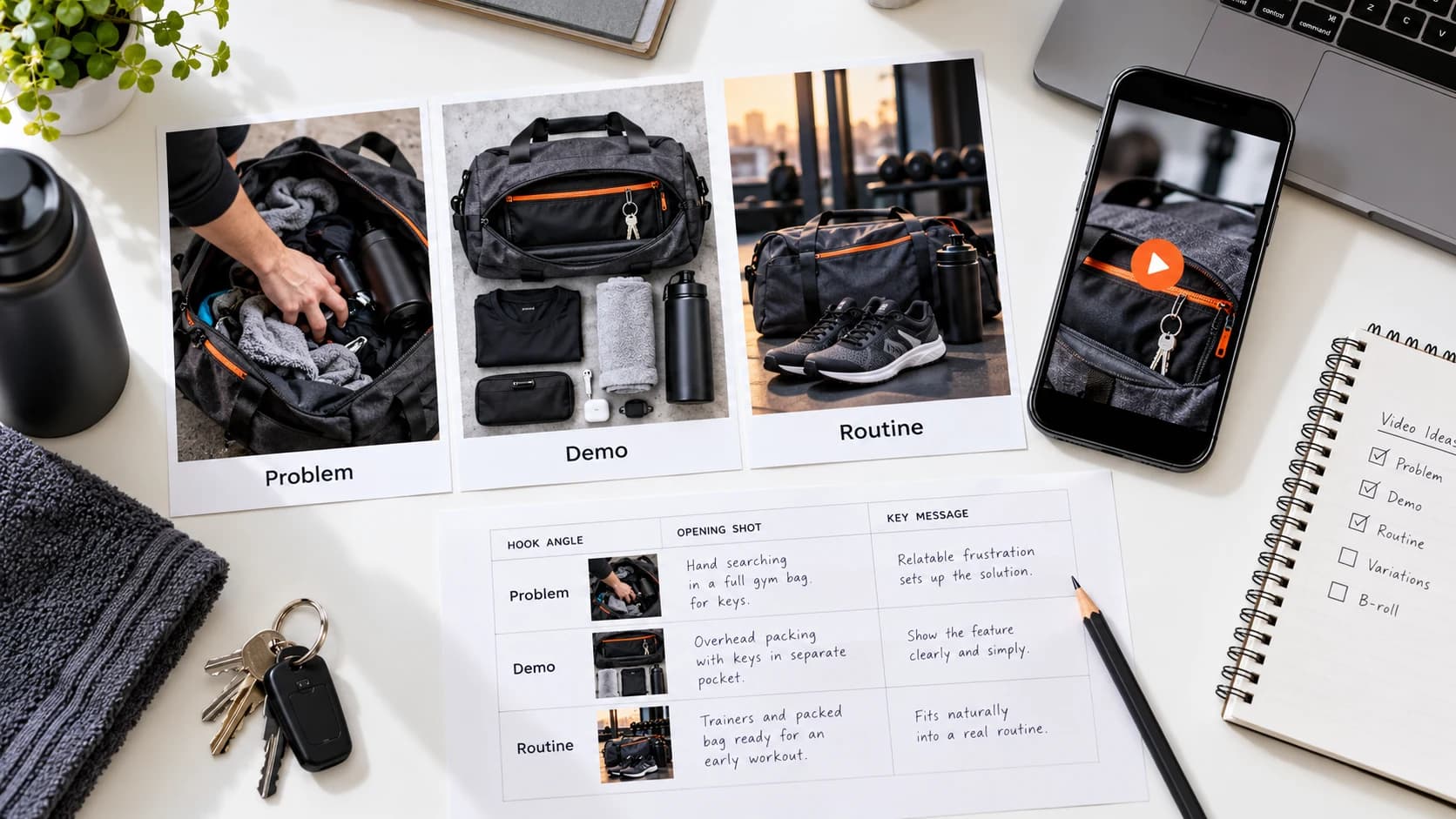
- Problem: “Still digging for your keys after every workout?” Open on a hand searching a packed bag.
- Demonstration: “Here’s where everything goes in my gym bag.” Open on a simple overhead packing shot.
- Routine: “My two-minute pack before an early workout.” Open on the bag beside a pair of trainers.
3. Make The Next Shot Answer The Hook
If you open with a question about lost keys, the next shot should show the relevant pocket. If you promise a packing routine, show the routine. Avoid an opening claim that the rest of the ad never demonstrates.
For AI video, choose a visual you can generate and inspect reliably. A simple close-up of a product may be more useful than a complicated sequence of hands interacting with several small objects. Use real footage where accurate behavior is essential.
4. Use AI To Explore, Then Edit
Ask for variations with explicit limits. Give the model your audience, verified product facts, and the shot you can actually make. Review the wording yourself and remove unsupported claims before recording or generating dialogue.
Example Prompt
Write three short opening hooks for a vertical ad for a gym bag with a separate key pocket. Audience: people who train before work. Create one problem hook, one demonstration hook, and one routine hook. Pair each with one simple opening shot. Use conversational language. Do not invent customer quotes, discounts, performance statistics, or features beyond the separate key pocket.
5. Compare One Meaningful Change At A Time
Keep the main demonstration, offer, call to action, and placement consistent while changing the opening. Name each file by its angle so you can connect results to the creative choice.
Decide which outcome matters before launching. Early viewing behavior can help you understand the opening, while clicks and conversions help assess what happens afterward. Compare results in the context of audience, spend, and delivery; a small sample is a signal to investigate, not proof of a winner.
Keep a short record of the hook, its opening visual, and what you learned. Use that record to choose the next test instead of repeatedly asking for more variations without a hypothesis.
Ready to try it? Open Supaviral Studio or explore the plans.